
How to Test Hydrogen Water at Home
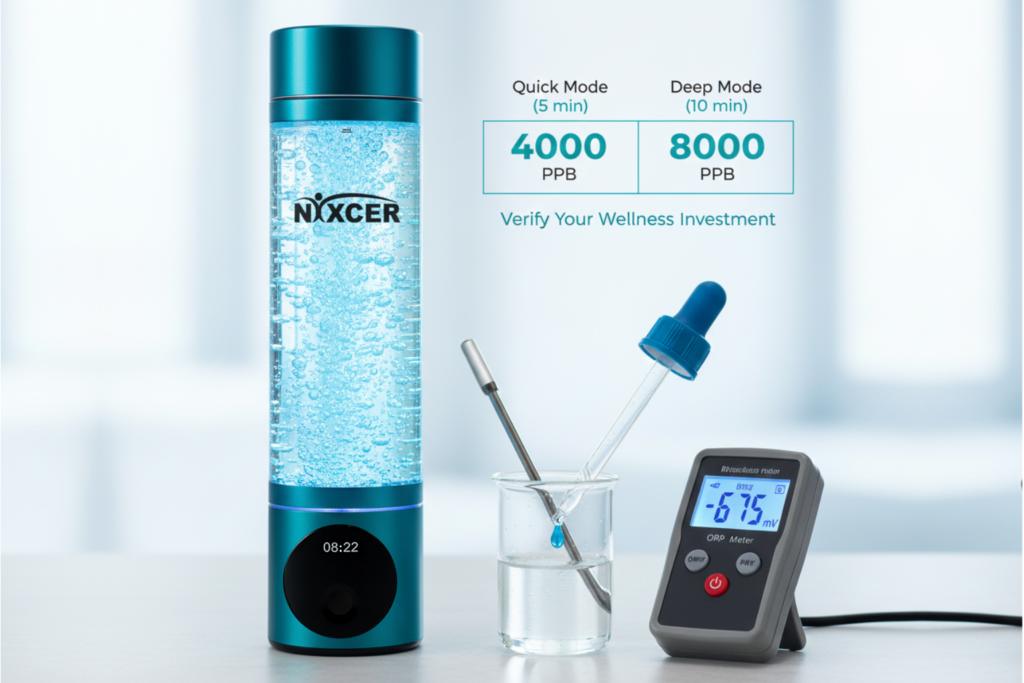
You’ve invested in a hydrogen water bottle—maybe even the high-performance Nixcer Pro hydrogen water bottle—but how do you know it’s actually delivering the molecular hydrogen it promises? With hydrogen gas dissipating within hours and many devices making bold claims, testing isn’t just recommended—it’s essential. This comprehensive guide walks you through every method available to test hydrogen water concentration at home, from affordable blue reagent drops to professional-grade digital meters, helping you verify your device performs as advertised and your wellness investment delivers measurable results. Why Testing Your Hydrogen Water Matters Most people buy hydrogen water bottles based on manufacturer claims alone, assuming the device works as promised. However, research shows hydrogen concentration can vary dramatically between products, and even the same device can perform differently based on water source, maintenance, and usage patterns. Testing transforms assumptions into certainty. The Hydrogen Dissipation Problem Molecular hydrogen is remarkably unstable in water. Unlike dissolved minerals that remain indefinitely, hydrogen gas actively escapes from liquid, with concentration dropping significantly within 1-2 hours in sealed containers and mere minutes in open containers. This rapid dissipation means timing matters immensely. A bottle generating 4000 PPB initially might offer only 1500 PPB an hour later, substantially reducing potential wellness benefits. Regular testing helps you understand your device’s actual delivery within practical usage windows. Verifying Device Performance Not all hydrogen bottles perform as advertised. Independent testing reveals many products generate far less molecular hydrogen than claimed, with some producing virtually zero measurable H2. Testing provides objective evidence your device works correctly, helps identify maintenance needs like electrode cleaning, and validates whether your specific unit matches published specifications. For premium devices like the Nixcer Pro claiming 8000 PPB output, verification ensures you receive the performance you paid for. Maximizing Your Health Investment Hydrogen water bottles range from $30 basic models to $200+ premium devices. Whether targeting athletic recovery, general wellness, or specific health goals, hydrogen concentration directly impacts effectiveness. Testing ensures therapeutic levels, confirms your chosen device meets your needs, and helps you make informed decisions about upgrades or replacements. When investing $90-130 in a Nixcer Pro, verification that you’re actually receiving 4000-8000 PPB concentrations justifies the premium pricing. Understanding Hydrogen Water Concentration Levels Before testing, understanding measurement units and therapeutic ranges provides context for interpreting results. PPM vs PPB: What Do These Numbers Mean? Hydrogen water concentration uses two interchangeable units. PPM (parts per million) measures milligrams of hydrogen per liter of water, while PPB (parts per billion) measures micrograms per liter. The conversion is simple: 1 PPM equals 1000 PPB. When you see a device claiming “3000 PPB,” that equals 3 PPM or 3 milligrams of hydrogen per liter. Most consumer devices rate performance in PPB because the numbers appear more impressive, but both measurements represent identical concentrations. The Nixcer Pro’s 8000 PPB output translates to 8 PPM, placing it at the top of consumer device capabilities. Therapeutic Concentration Ranges Research on hydrogen water typically uses concentrations between 0.5-1.6 PPM (500-1600 PPB) as therapeutic baselines. Studies suggest benefits begin around 0.5 PPM, with optimal effects often observed between 1.0-1.6 PPM. Higher concentrations don’t necessarily provide proportionally greater benefits due to saturation limits, but they offer advantages for immediate consumption and account for rapid hydrogen dissipation. Devices producing 3000+ PPB ensure therapeutic levels remain even after 30-60 minutes of storage, providing practical flexibility for real-world usage. What the Nixcer Pro Delivers The Nixcer Pro hydrogen water bottle offers two operational modes targeting different needs. Quick Mode runs 5 minutes generating approximately 4000 PPB—well above therapeutic thresholds and suitable for immediate consumption. Deep Mode extends to 10 minutes, producing up to 8000 PPB maximum concentration. This dual approach balances convenience with maximum performance. The 4000 PPB quick mode already exceeds most competitors’ maximum output, while the 8000 PPB deep mode provides extraordinary concentrations for users seeking maximum benefits. These levels maintain therapeutic ranges even after 1-2 hours storage, unlike lower-output devices whose concentration drops below effective thresholds quickly. The 3 Main Methods to Test Hydrogen Water Home testing options range from simple visual confirmation to precise quantitative measurement. The three primary methods vary in accuracy, cost, and convenience. Blue reagent drop testing offers the best balance of affordability and reliability for most users, providing quantitative measurements at reasonable cost. Digital hydrogen meters deliver instant readings with minimal effort, though quality varies significantly between models. ORP meters provide indirect indicators of hydrogen presence but cannot accurately measure concentration. Each method serves different priorities, and understanding their strengths and limitations helps you choose the approach matching your needs and budget. Method 1: Blue Reagent Drop Testing (H2Blue) Blue reagent testing represents the most widely recommended method for home hydrogen water testing, offering quantitative measurements at accessible cost with reasonable accuracy. How Blue Reagent Testing Works Blue reagent testing uses methylene blue chemistry in a process called titration. The reagent contains methylene blue molecules that react with dissolved hydrogen gas, creating colorless fluoroethylene blue. When you add reagent drops to a measured water sample, the blue color disappears as long as hydrogen molecules remain available to react. Once all hydrogen is consumed, additional drops stay blue—signaling the titration endpoint. By counting drops required to reach this point, you calculate the precise hydrogen concentration. Each drop typically represents 100 PPB (0.1 PPM), making calculation straightforward. The chemistry relies on a one-to-one molecular reaction between hydrogen and methylene blue in the presence of colloidal platinum catalyst. This specificity ensures the test measures actual dissolved H2 rather than other substances. However, the reagent is sensitive to oxidation, and exposure to air, light, and contamination gradually reduces effectiveness. Proper storage in cool, dark conditions and tight sealing after use maintains reagent reliability. Step-by-Step Testing Process Equipment needed: H2Blue reagent kit (available from various suppliers), 6ml graduated test beaker (usually included), glass dropper (included), stirring rod, gloves and protective eyewear (recommended). Testing procedure: Calculating Your Results Calculation is simple multiplication. Each drop of H2Blue reagent represents 100 PPB of dissolved hydrogen in a 6ml sample. Multiply